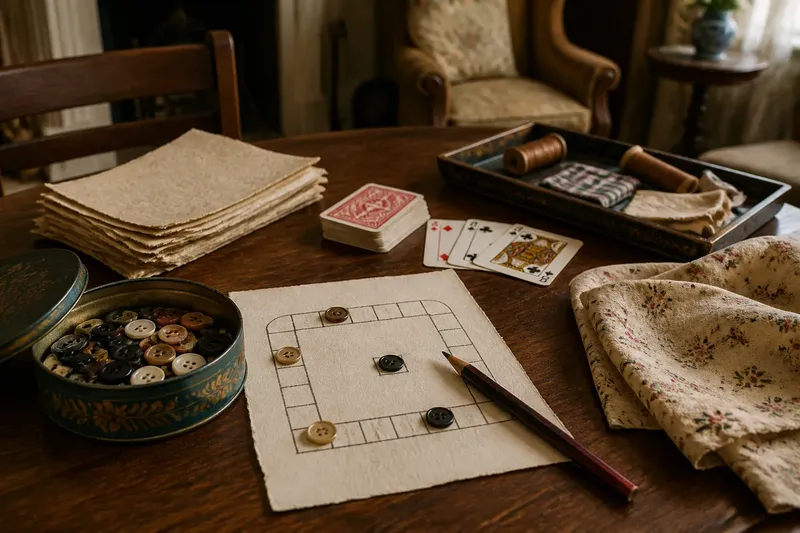
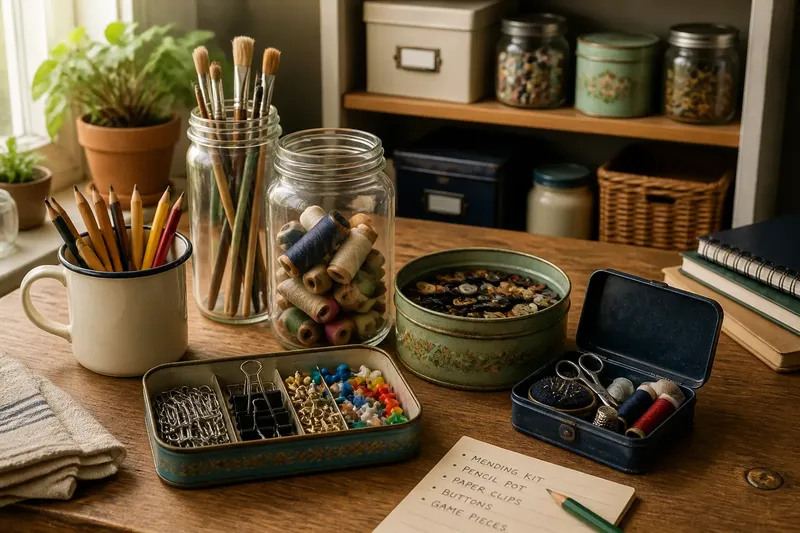
The Supply Pile Is Not the Activity
Creative projects need not begin with a shopping list. Start with one available material and a small finished aim to turn preparation into making.
Creative projects begin with a decision, not a collection of supplies. A drawer of paper, buttons and unopened glue can look industrious, but until one material is used to make something, the project remains an intention. Choosing a defined result gives a free afternoon a direction without requiring a trip to the craft shop.
Imagine Rowan has a rainy Saturday, leftover paper, a few plain envelopes and a wish to make a card for a friend. An online list of craft ideas suggests decorative tools and special paper. In this invented situation, Rowan closes the list, chooses one envelope and decides to make a card that will fit inside it. The expected result is one usable card, not a newly expanded collection of supplies.
Choose a clear result
Collecting materials can postpone the difficult part: deciding what to make. A supply pile keeps several possibilities open, which is agreeable until none of them becomes an actual project. Preparation has its place—a clean table and a pencil are useful—but it needs a stopping point.
Give the session an endpoint that can be seen or held. “Make one card with room for a message” is clearer than “make something lovely”. The result can be plain, wonky or amusing; it only needs to meet the purpose you chose.
Put away anything that has no job in the chosen result.
Work within the material
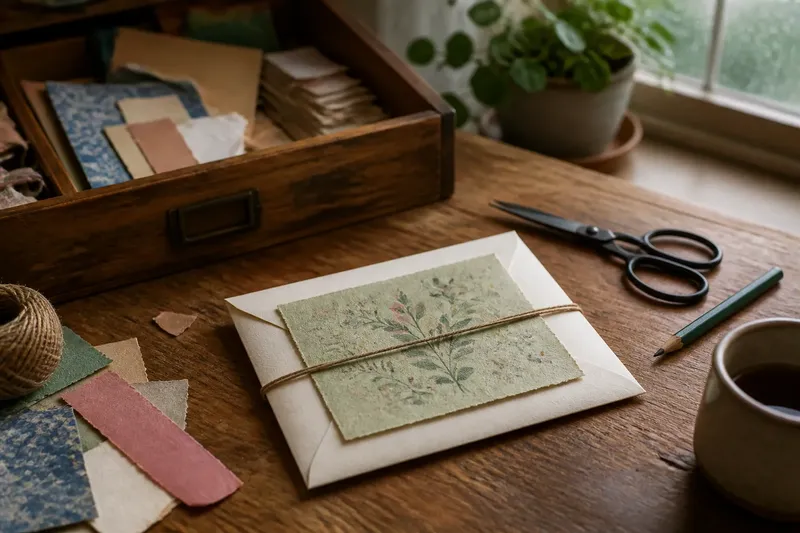
Rowan takes out coloured scraps and one envelope, leaving the rest of the drawer closed. The envelope sets the card’s size, while the scraps provide colour. Rowan tries a paper panel against the envelope and finds that a scrap is too narrow to cover the whole front. Rather than abandon the card, Rowan makes the panel smaller and leaves the envelope visible around it.
This is adaptation: changing the design to suit the available material. Escalation is different: keeping the original design and shopping for what it requires. Either can be reasonable, but a small change is often enough. If the object still serves its purpose, a less elaborate design is not a failed version of the original.
Say the paper panel lifts at its corners. Rowan tries a short length of string as a band around the envelope instead of seeking stronger glue. The expected observable result is a closed envelope with the card inside; if the band slides off, Rowan leaves it out and uses the envelope without a fastening. The decision follows what the material actually does, rather than what an imagined project might require.
When is more material needed?
What makes a useful starting material?
Choose something already available that is clean, usable and suited to the intended activity. If it is damaged or unsuitable, choose a different material rather than forcing it into service.
How small should the aim be?
Make it one contained piece of work, such as a card or a sketch of a kitchen plant. If the aim has no clear stopping point, narrow it until you can tell when the session’s result is complete.
When should you buy a supply?
Consider buying something when an actual attempt reveals a specific obstacle that prevents the intended result. If a simpler design would still serve the purpose, adapt the design; if not, decide whether the missing material is worth obtaining.
What if the result looks rough?
Check whether it works for its intended purpose before adding supplies. If a crooked edge makes the card awkward, trim it; if the card carries its message clearly, leave it as it is.
Keep the session contained
A limited working area helps the chosen project stay distinct from the rest of the supply drawer. Rowan clears one corner of the table, keeps the paper scraps and envelope there, and returns unrelated items to the drawer. This is not a rule against using several materials. It is a way to make each additional item answer a simple question: what does it contribute to this result?
- Check whether the material is clean and usable; if it is, try it, and if not, choose another material.
- Check whether the chosen object has a clear purpose; if it does, keep the aim, and if not, narrow it to one finished item.
- Check whether the available material fits the design; if it does, proceed, and if not, change the design or choose a better-suited material already on hand.
- Check whether an extra tool solves a problem in the current attempt; if it does, use it, and if not, put it away.
- Check whether the object works despite a rough edge; if it does, stop, and if not, make one simple repair or simplify the design.
- Check whether a missing supply blocks the intended purpose; if it does, consider obtaining it, and if not, adapt the project rather than shopping.
For Rowan, the decisions are straightforward: the paper is usable, the card has a clear purpose, and the narrow scrap works as a panel once the design changes. The string is optional, so it stays out unless the envelope needs a band. The expected result is a card that fits its envelope, with the rest of the drawer still available for another day.
Let the result guide later
When the card is finished, Rowan puts the unused scraps away and keeps the card separate from the working materials. A brief note—“small panel worked; full cover did not”—would record a useful design choice without turning the pastime into an inventory exercise.
Creative projects need not end in a polished object. If the card carries its message, the purpose is met; if Rowan stops after making the panel, that is a clear piece of progress too. The supply pile can wait until a real project gives it a job.